 ALKAMAR
Investment Limited
ALKAMAR
Investment Limited
Practice
Artificial intelligence
Grounded in doctoral research, and in working across every major model rather than betting the design on one.
ALKAMAR
Investment Limited
Practice
Grounded in doctoral research, and in working across every major model rather than betting the design on one.
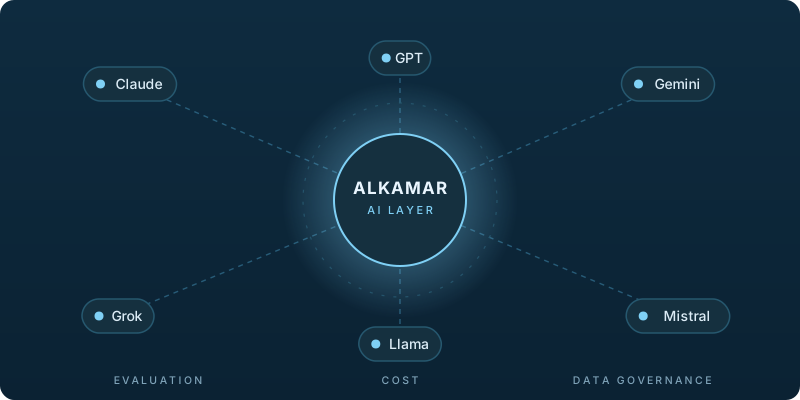
Our director is completing a doctorate in computer science specialising in artificial intelligence, and that work feeds directly into what we build. We treat AI as an engineering component with the same requirements as any other: it has to be measurable, affordable to run, and safe with the data it is given.
That last requirement is the one most projects discover late. A feature that calls a model sends something out of your estate, and somebody has to be able to say exactly what, to whom, and what they may keep.
We are not a reseller for one vendor. We have built on all of them, and we choose per workload — on quality for that task, on cost per call, on latency, and on where the data is allowed to go.
Where data cannot leave the country or the building, we run open-weight models on your own hardware instead. That is an infrastructure decision as much as an AI one, which is why it sits in the same team as the server and data centre practice.
Putting models into real products — content generation, transcription, summarisation and ranking — with cost, latency and failure handled before launch rather than after.
What leaves your estate when a feature calls a model, what a provider may keep, and how to say so honestly in a privacy notice. The questions that decide whether a deployment survives an audit.
Doctoral work in enhanced artificial intelligence, applied to security operations: detection, triage and the automation of work that does not need a person at three in the morning.
PopVibe uses AI in production today — generating local news summaries, transcribing speech to burn captions onto video, and ranking what a member sees. Each of those was a decision about cost and privacy as much as about capability, and each is disclosed in the app’s privacy policy by name.